
Description
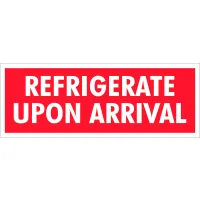
Tape Logic® Labels with “Refrigerate Upon Arrival” Print are professional-grade adhesive labels designed to clearly communicate temperature-sensitive shipping requirements to handlers and recipients. These 4″L x 1-1/2″W warning labels come in rolls of 500 units and feature bold red and white printing to ensure immediate visibility on packages containing perishable goods, pharmaceuticals, biologics, and temperature-controlled products.
Each label in this roll features pre-printed text stating “Refrigerate Upon Arrival,” eliminating the need for manual writing and ensuring consistent, legible messaging across your entire shipment volume. The adhesive backing is engineered for reliable application on corrugated cardboard, kraft paper, plastic, and other standard shipping surfaces, maintaining secure placement even under temperature fluctuations and moisture exposure during transit. The 4″ x 1.5″ dimensions provide sufficient real estate for the warning text to remain readable from standard handling distances, while the red and white color scheme leverages high-contrast visibility standards recognized across logistics, cold chain management, and FDA-compliant shipping protocols. With 500 labels per roll, this quantity serves mid-to-large volume shippers while remaining cost-effective for regular operational use. The labels are fade-resistant and maintain adhesion integrity throughout standard shipping timeframes, whether packages experience refrigerated, ambient, or transitional temperature environments.
Cold chain logistics providers, pharmaceutical distributors, food service suppliers, medical device manufacturers, and e-commerce businesses shipping perishables rely on these labels to meet regulatory requirements and protect product integrity. Common applications include labeling shipments of frozen foods, fresh produce, temperature-sensitive medications, laboratory samples, vaccines, insulin, biologics, seafood, dairy products, and specialty food items. Restaurants, catering companies, clinical laboratories, hospitals, vaccine clinics, and direct-to-consumer food brands use these labels to communicate handling instructions to receiving personnel, reducing the risk of temperature-related product damage and spoilage. Companies operating under USDA, FDA, or GMP compliance frameworks often standardize on warning labels like these to document proper handling procedures and maintain audit trails demonstrating due diligence in cold chain management.
When selecting adhesive warning labels for temperature-sensitive shipments, evaluate several critical factors: adhesion strength appropriate to your packaging materials and shipping duration, readability under various lighting and distance conditions, weather and moisture resistance for packages exposed to humid or wet environments, and compliance alignment with industry standards and customer expectations. Consider whether pre-printed messaging matches your specific requirements or if customization is necessary; these labels feature standard “Refrigerate Upon Arrival” text suited to most cold chain applications. Assess roll quantity based on your monthly shipping volume to balance inventory management with per-unit cost efficiency. Evaluate the label’s size and placement versatility—the 4″ x 1.5″ format accommodates various box dimensions without consuming excessive label space. Finally, confirm that the label material is compatible with automated labeling equipment if you plan to integrate these into high-volume fulfillment operations.
What size are these warning labels, and will they fit on small or oversized boxes?
These labels measure 4 inches long by 1.5 inches wide, providing ample space for the pre-printed “Refrigerate Upon Arrival” text while remaining proportional to standard shipping boxes. This size is suitable for most corrugated boxes used in cold chain shipping, from small parcels (6″ x 6″ x 6″) through large containers (24″ x 18″ x 18″). For extremely small packages or envelopes, you might consider trimming the label or selecting a smaller format; for oversized pallets or large freight containers, multiple labels ensure visibility from multiple angles. The rectangular orientation works well on box sides and top surfaces where handlers typically first observe handling instructions.
How do I apply these labels to ensure they stay adhered during refrigerated and frozen shipping?
Clean and dry the box surface where you plan to place the label—moisture, dust, or frost prevents proper adhesion. Apply firm, even pressure across the entire label surface for at least 3-5 seconds, ensuring all edges make full contact with the box. Avoid applying labels to extremely cold surfaces immediately after removal from freezers, as condensation can compromise the bond; allow boxes to reach room temperature before labeling if possible. The adhesive formulation is designed to remain tacky through temperature swings, but proper initial application is essential for long-term durability. If shipping in high-humidity environments, consider applying labels at least 30 minutes before packaging to allow the adhesive to set fully.
What is the difference between these pre-printed labels and blank labels I could write on myself?
Pre-printed labels like these offer consistency, legibility, professionalism, and compliance documentation advantages over handwritten alternatives. Handwritten labels are prone to illegibility, inconsistency, and smudging, especially



Reviews
There are no reviews yet.