
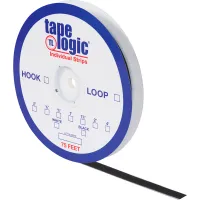
Description
Tape Logic® Hook Tape Individual Strips with Adhesive is a pressure-sensitive fastening solution designed for quick, repositionable attachment of lightweight items in warehouses, distribution centers, and manufacturing facilities. This 75-foot roll of 2-inch-wide black hook tape strips provides reliable temporary bonding without permanent adhesive residue, making it ideal for labeling, securing documentation, or attaching components during assembly and shipping operations.
These individual hook tape strips feature a robust acrylic-based adhesive that activates with firm hand pressure, requiring no heat guns, water activation, or specialized equipment. The polyester backing ensures durability and resistance to tearing, while the pressure-sensitive adhesive formulation delivers consistent holding power across repeated applications. Each strip measures 75 feet in total length and 2 inches in width, allowing for custom sizing and flexible deployment across multiple workstations. The black coloring provides professional appearance and visibility on most surfaces, from corrugated boxes to metal containers. The repositionable adhesive system allows items to be removed and reattached without damaging surfaces or leaving sticky residue, making these strips particularly valuable for temporary holding applications where permanence is not required.
Distribution and fulfillment operations rely heavily on hook tape strips for securing shipping labels, manifests, and tracking documentation to packages without interfering with scanning or handling. Manufacturing plants use these strips during assembly line operations to temporarily position components before permanent fastening. Warehouse management teams deploy hook tape for organizing inventory bins, securing safety signage, and marking merchandise for quality control checkpoints. Retailers use the strips in receiving departments to attach handling instructions and special processing notes. E-commerce packaging facilities benefit from the quick-stick application method that accelerates throughput without slowing production lines. The repositionable nature makes these strips valuable in environments where items are frequently relocated, reconfigured, or returned—common scenarios in reverse logistics operations and temporary storage situations.
When selecting hook tape strips for your operation, prioritize adhesive strength rating in relation to the weight and surface texture of items you’ll be securing. Smooth, non-porous surfaces like plastic film and coated cardboard achieve maximum tape adhesion, while rough or contaminated surfaces may require surface preparation for optimal holding power. Consider your environmental conditions—temperature fluctuations and humidity levels affect pressure-sensitive adhesive performance, so verify temperature ranges for your application environment. Evaluate whether repositionability or permanent bonding better serves your workflow; hook tape excels at temporary attachment, but if permanent fastening is needed, pressure-sensitive adhesive alternatives without repositionable properties offer superior long-term holding. Review your tape width requirements carefully—the 2-inch width suits most labeling and documentation tasks, but verify against your specific application needs. Assess volume requirements and calculate cost-per-foot to ensure your inventory planning aligns with production velocity and peak seasonal demand periods.
What size strips should I cut from the 75-foot roll?
The ideal strip length depends on your application. For securing standard shipping labels to corrugated boxes, cuts of 4–6 inches typically provide sufficient holding area without excess waste. For manifests or multi-page documentation packets, 8–12 inch strips offer better stability and prevent edge peeling. Custom cutting allows flexibility—store the roll in a dry location and cut strips as needed using a utility knife or tape dispenser, minimizing premature adhesive degradation from extended air exposure.
How do I maximize adhesive performance on textured or contaminated surfaces?
Pressure-sensitive adhesives require clean, dry contact surfaces for optimal bonding. Before applying hook tape, wipe surfaces with a lint-free cloth to remove dust, oils, and debris that reduce contact area and adhesive transfer. On rough corrugated cardboard, apply firm pressure (using hand pressure or a roller tool) for 10–15 seconds to maximize adhesive penetration into surface irregularities. On contaminated surfaces like those in outdoor receiving areas, light solvent cleaning may be necessary—consult material safety data for compatible cleaning agents that don’t degrade the tape backing.
What is the difference between hook tape and loop tape, and which do I need?
Hook tape features a rough, grabbing surface designed to catch on complementary loop tape or fuzzy surfaces, creating a mechanical fastening bond rather than relying solely on surface adhesion. Loop tape (the companion product) provides a soft, fuzzy backing that hooks grip. Many applications use hook tape exclusively for single-surface attachment to cardboard, plastic, or metal without requiring loop tape. However, if you’re creating reusable fastening systems where items attach to carriers or pallets repeatedly, pairing hook and loop tapes together provides superior holding power and durability compared to hook tape alone.
Order Tape Logic® Hook Tape Individual Strips today and


Reviews
There are no reviews yet.