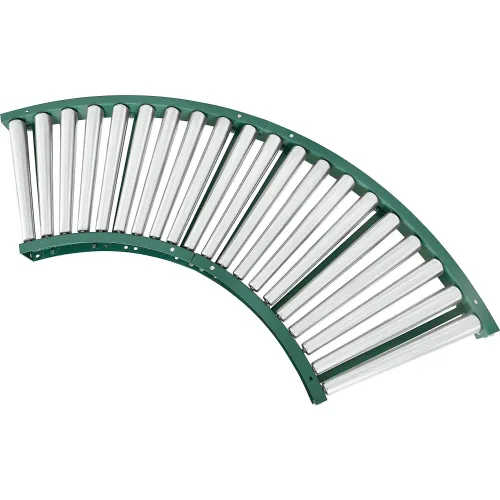
Description
The GRAVITY ROLLER CONVEYOR 90 DEGREE CURVED SECTION 21″ is a precision-engineered curved conveyor module designed to redirect product flow at right angles without powered assistance. This gravity-fed roller system is essential for warehouses, distribution centers, and manufacturing facilities that need smooth, efficient directional changes in their material handling operations.
This curved section features a 21-inch frame width with industrial-grade steel construction and sealed ball bearings that enable consistent, low-friction rotation of the steel rollers. The 90-degree bend configuration allows products to transition seamlessly from one conveyor line to another while maintaining proper spacing and alignment. The unit utilizes gravity and slight product momentum to propel items through the curve, eliminating the need for electric motors or additional power sources at this junction point. The roller diameter, axle spacing, and frame geometry are optimized for standard pallet jack compatibility and integration with existing conveyor systems. Each roller operates on precision bearings rated for continuous duty cycles, and the modular design allows for quick installation between straight conveyor sections without special tools or extensive downtime.
Gravity roller conveyors of this type serve industries including food processing and beverage distribution, pharmaceutical manufacturing, automotive parts assembly, e-commerce fulfillment, and general warehouse logistics. Facilities use 90-degree curved sections to navigate space constraints, redirect products between departments, or connect conveyor lines that run perpendicular to each other. This particular 21-inch width model is popular in mid-scale operations handling boxes, cartons, small pallets, and case goods. The curved design reduces product jams compared to sharp 90-degree transfers and maintains smooth velocity during directional changes, making it ideal for light to medium-duty applications where product protection and throughput efficiency matter.
When selecting a curved roller conveyor section, evaluate the product weight capacity per roller and total load supported by the curve assembly. Consider the diameter and spacing of the rollers relative to your specific product dimensions—smaller items may require closer roller spacing, while larger pallets need wider spacing. Assess whether you need ball bearing rollers (recommended for continuous operation) or standard sleeve bearings (acceptable for intermittent use). Verify compatibility with your existing conveyor frame width and mounting system, and confirm that the 90-degree angle precisely matches your facility layout. Check whether the section includes leveling feet, brake provisions, or guard rail attachments for your safety and operational requirements. Consider future scalability—purchasing modular sections allows for easy expansion or reconfiguration as your facility needs evolve.
What size products can this 21-inch curved section handle?
The 21-inch frame width accommodates products up to approximately 20 inches wide, accounting for proper clearance on both sides of the conveyor. This size handles standard corrugated boxes, plastic crates, small cartons, and lighter pallets. Maximum product weight depends on the roller diameter and bearing type—typically 100–300 pounds per roller for gravity systems. Consult the product specifications or contact our sales team with your exact product dimensions and weight to confirm suitability for your application.
How do I integrate this curved section with my existing straight conveyor lines?
The 90-degree curved roller conveyor connects via standard frame-mounting points that align with most industrial conveyor systems. Position the curved section at the junction where two perpendicular conveyor lines meet, ensuring roller heights are level to create a smooth transition. Secure the unit to your frame using the included or recommended fasteners, and verify that product flow direction is correct before operation. The gravity-fed design requires no electrical connection, so installation is purely mechanical. If your existing system uses powered rollers, you may optionally add a motor to the curved section for enhanced control, though gravity operation alone typically suffices for standard applications.
What is the difference between gravity roller conveyors and powered conveyor systems?
Gravity roller conveyors rely on product weight and manual or slight inclined-plane momentum to move items along the line, making them energy-efficient and ideal for distribution facilities where products flow consistently. Powered conveyor systems use electric motors to drive the rollers, offering precise speed control and the ability to move products uphill or maintain consistent velocity on flat surfaces. Gravity systems are lower-cost, require minimal maintenance, have no electrical infrastructure needs, and work well for 90-degree curves like this model. Powered systems are better for high-speed, automated operations requiring exact timing or product sequencing. For this curved section, gravity operation is standard and highly effective in most warehouse and manufacturing environments.
Order the GRAVITY ROLLER CONVEYOR 90 DEGREE CURVED SECTION 21″ (SKU: 293191) today with fast shipping and confirmed availability from our industrial supply warehouse.
“`




Reviews
There are no reviews yet.