Description
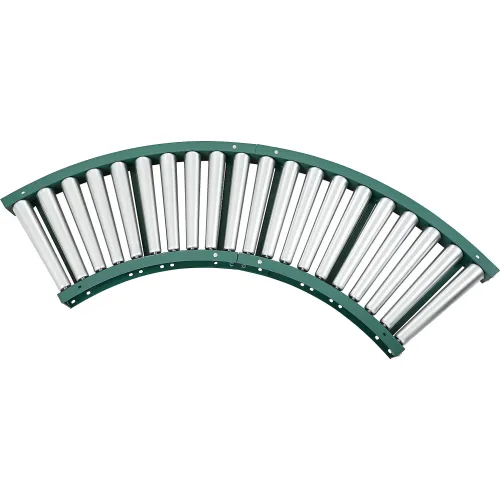
The Gravity Roller Conveyor 90 Degree Curved Section 15″ is a precision-engineered conveyor component designed to redirect product flow at right angles without powered assistance. This curved roller section integrates seamlessly into existing gravity conveyor systems to enable smooth transitions around corners, maximizing warehouse space utilization and streamlining material handling operations.
Key Features and Specifications: This 90-degree curved section features a 15-inch frame width that accommodates standard pallet jack and hand truck access throughout your conveyor line. The unit utilizes gravity roller technology, allowing products to move through the curve via natural gravitational force without electricity or motor requirements, reducing operational costs and maintenance complexity. The curved frame design distributes load evenly across multiple steel rollers arranged in a precise arc pattern, ensuring consistent product advancement regardless of item weight or dimensions. The rollers feature sealed roller bearings that minimize friction while extending service life in demanding warehouse environments. The powder-coat finished steel frame resists corrosion and impact damage, ensuring durability in industrial settings including manufacturing facilities, distribution centers, and high-volume logistics operations. The 15-inch width specification matches common roller conveyor configurations, enabling straightforward integration with existing systems without requiring custom fabrication or adapters.
Applications and End Users: This curved section serves food processing facilities, beverage distribution, pharmaceutical warehouses, e-commerce fulfillment centers, and general manufacturing plants requiring material flow optimization. Operations managers use 90-degree curved sections to navigate product around structural columns, connect multiple conveyor lines, or reroute materials to different warehouse zones. The gravity-driven conveyor approach appeals to facilities prioritizing sustainability and operational simplicity—the system requires no electrical infrastructure modifications and eliminates motor failure risks. Common applications include order picking operations, package sorting, carton conveyance, pallet staging, and light-to-medium load distribution. Manufacturing environments use curved sections to guide components between assembly stations, while warehouse management teams deploy them to create efficient, compact conveyor layouts that maximize throughput while minimizing square footage requirements.
What to Consider When Selecting Curved Roller Conveyor Sections: Verify that the 15-inch frame width matches your existing gravity conveyor system specifications—mismatched widths compromise alignment and product tracking. Assess the load capacity per roller against your typical product weights; undersized equipment accelerates wear and failure, while oversizing increases unnecessary cost. Examine roller diameter and spacing specifications to ensure compatibility with your product dimensions—items requiring support across multiple rollers need closer spacing than larger packages. Confirm roller material composition; steel rollers suit dry goods and non-corrosive products, while stainless steel rollers handle wet environments, food processing, and washdown applications. Consider the curve radius and angle specifications relative to your layout requirements—90-degree sections work for perpendicular directional changes, but verify structural clearances and approach angles accommodate your material handling equipment. Evaluate whether your system uses ball bearing rollers versus sleeve bearings; ball bearings offer superior performance in high-speed, high-frequency operations, while sleeve bearings provide economical solutions for moderate-duty applications. Finally, assess frame construction quality and weld integrity—industrial-grade equipment should feature reinforced joints and quality finishes that withstand constant operational stress.
What size products can this 15-inch curved section accommodate?
The 15-inch frame width accommodates products ranging from small packages (boxes starting at 4 inches wide) up to moderately sized items, with optimal performance for 8-15 inch wide packages. Maximum product length depends on your complete conveyor system configuration, but individual curved sections handle standard carton heights and depths without restriction. For oversized or unusually shaped items, verify that product geometry allows proper tracking through the 90-degree curve arc.
How do I determine if my existing gravity conveyor system is compatible with this curved section?
Compare your current system’s roller spacing, frame width, and roller diameter against this product’s specifications. The 15-inch width must match your existing conveyor width precisely. Verify that incoming and outgoing sections align properly with the curved section’s connection points. Consult your original conveyor documentation or contact a material handling specialist to confirm dimensional compatibility before purchasing.
What is the difference between gravity roller conveyors and powered roller conveyors for curved sections?
Gravity roller conveyors rely on slope and product momentum to move items through curves, requiring no electricity, reducing maintenance, and lowering operational expenses. Powered roller conveyors use motors to drive rollers, enabling operation on level surfaces and providing consistent speed control, but demand electrical infrastructure, regular motor servicing, and higher upfront investment


Reviews
There are no reviews yet.