Description
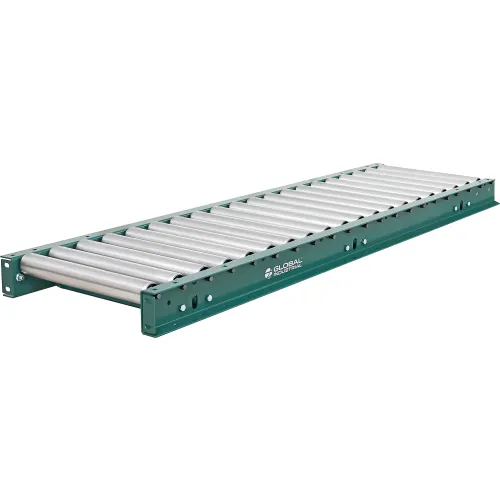
The GRAVITY ROLLER CONVEYOR 5FT 21″ 4.5″ AXLE is a straight-section powered conveyor system designed for horizontal material handling and product transfer applications. This industrial-grade conveyor leverages gravity and roller mechanics to move packages, cartons, and pallets efficiently through warehouses, distribution centers, and manufacturing facilities without requiring constant motor engagement.
Key Features and Specifications: This gravity roller conveyor offers a 5-foot length with a 21-inch frame width, making it ideal for standard pallet and carton widths in most material handling operations. The 4.5-inch axle center spacing ensures smooth, consistent product movement while minimizing gaps that could catch items. With an impressive 520 lbs per linear foot load capacity, this conveyor handles heavy-duty applications including full pallets, bulky cartons, and industrial components. The straight-section design integrates seamlessly into existing conveyor lines, accumulation systems, and sortation operations. Steel construction and precision-engineered rollers deliver durability and low-maintenance operation, while the gravity-fed mechanism reduces energy consumption compared to motorized alternatives.
Applications and Industries: This conveyor system serves diverse sectors including e-commerce fulfillment, food and beverage processing, automotive parts distribution, pharmaceutical manufacturing, and general warehouse operations. Manufacturing plants use gravity roller conveyors for assembly line material flow, work-in-process staging, and finished goods accumulation. Third-party logistics (3PL) providers and fulfillment centers integrate these units into pick-and-pack stations, packing lines, and shipping dock operations. Retailers and distribution centers rely on gravity roller conveyors for cross-docking, order consolidation, and conveyor loop systems. The modular design allows integration with belt conveyors, powered roller conveyors, and diverter systems to create complete material handling solutions.
What to Consider When Selecting Gravity Roller Conveyors: When evaluating gravity roller systems, prioritize load capacity relative to your heaviest products—the 520 lbs/ft rating on this unit suits standard warehouse loads but may require reinforcement for heavier applications. Measure your frame width requirements carefully; the 21-inch width accommodates most standard pallets and carton sizes but verify compatibility with your specific products. Consider roller diameter and spacing (the 4.5-inch axle center) to prevent product sagging or irregular movement. Assess whether a straight section meets your layout needs or if you require curved, decline, or incline configurations. Evaluate accumulation requirements—gravity conveyors naturally accumulate products without motorized backpressure, ideal for queue management but requiring space. Review installation requirements, including frame mounting, integration points with existing conveyors, and whether you need support legs, brackets, or adapters. Consider long-term maintenance accessibility for roller replacement and cleaning, particularly in food processing or dusty environments.
What size conveyor do I need for my pallet loads?
Measure your pallet width and product depth, then confirm compatibility with this unit’s 21-inch frame width—suitable for standard 40″ x 48″ pallets. Check your heaviest loaded pallet weight and divide by the conveyor length to ensure it doesn’t exceed the 520 lbs per linear foot capacity. For a 40-pound carton on a 5-foot section, you’re well within capacity; however, heavier industrial loads may require multiple sections or alternative conveyor types.
How do I install this gravity roller conveyor into my existing line?
This straight-section gravity roller conveyor connects to adjacent conveyors via frame mounting brackets or bolted connections at the inlet and discharge ends. Ensure proper conveyor alignment by using a straightedge and shim packs if necessary to prevent product binding. The unit should be mounted on a stable support structure or conveyor stand, with adequate clearance for roller access during maintenance. Integration with powered sections typically requires transition plates to ensure smooth product transfer between systems.
What is the difference between gravity roller and powered roller conveyors?
Gravity roller conveyors rely on product momentum and slight deck incline for movement—energy-efficient, lower operating costs, and ideal for continuous downhill flow. Powered roller conveyors use motors to drive rollers, offering precise speed control, uphill capability, and better handling of irregular items. Choose gravity systems for high-volume, consistent flow with gravity-assist capability; select powered systems when you need accumulation, speed variation, or uphill transport.
Stock availability and expedited shipping options ensure rapid delivery to your facility—order today for fast turnaround on this essential material handling component.
“`



Reviews
There are no reviews yet.