Description
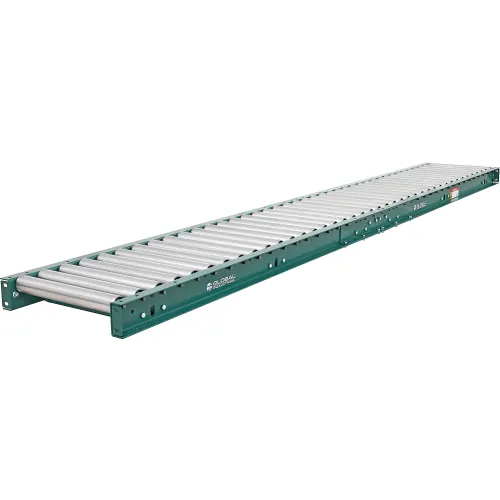
The GRAVITY ROLLER CONVEYOR 10FT 15″ 4.5″ AXLE is a straight-section powered-free conveyor system designed for material handling operations that rely on gravity flow and manual or assisted product movement. This industrial-grade conveyor is purpose-built for warehouses, distribution centers, manufacturing facilities, and assembly lines that need reliable, low-maintenance product transfer without the complexity of motorized systems.
Built with a robust steel frame construction, this gravity roller conveyor features a 10-foot length with a 15-inch frame width and 4.5-inch roller axle center spacing, delivering a substantial 100 lbs per linear foot load capacity. The roller design minimizes friction while maintaining precise product control, making it ideal for boxes, cartons, pallets, and packages of varying weights. The conveyor’s straight configuration allows for seamless integration into existing conveyor line systems, and the standardized 4.5-inch axle measurement ensures compatibility with industry-standard components and replacement rollers. The steel roller construction provides durability for high-frequency use environments, while the gravity-driven mechanism eliminates electrical dependency and reduces operational costs associated with motorized alternatives. The 15-inch width accommodates mid-sized packages and containers, striking an optimal balance between throughput capacity and space efficiency in compact warehouse settings.
This gravity conveyor system serves a broad range of industrial sectors including e-commerce fulfillment operations, food and beverage processing facilities, pharmaceutical distribution, automotive parts assembly, and general manufacturing environments. Warehouse managers and logistics coordinators implement these conveyors in packing stations, sorting areas, and inter-stage transfer points where products flow downhill or are manually advanced along the roller surface. Small to mid-sized manufacturers utilize gravity roller conveyors for assembly line progression, component feeding, and finished goods staging. The 100 lbs/ft capacity makes this model particularly suitable for medium-weight applications—typical for boxed merchandise, plastic containers, metal components, and wrapped goods—rather than extremely heavy industrial materials or lightweight parcels requiring specialized handling.
When selecting a gravity roller conveyor system, evaluate the load weight and dimensions of your typical products to ensure the 100 lbs/ft capacity aligns with your operational requirements; heavier items may require reinforced frames or multiple units. Consider the installation environment—verify ceiling height, floor space, and accessibility for maintenance, as gravity conveyors require occasional cleaning and roller inspection to maintain smooth operation. Assess whether your facility has existing conveyor infrastructure that this 10-foot straight section can integrate with, checking for compatible mounting points and roller spacing standards. Determine the incline angle if this conveyor will be positioned on a slope, as gravity effectiveness depends on proper pitch for reliable product advancement. Finally, review your throughput demands and product flow patterns to confirm that the 15-inch width and manual-assist gravity operation meet your production velocity and handling efficiency standards without creating bottlenecks in your material flow sequence.
What size products can this gravity roller conveyor handle?
The GRAVITY ROLLER CONVEYOR 10FT 15″ 4.5″ AXLE accommodates products with widths up to approximately 14 inches to safely clear the 15-inch frame width. The 4.5-inch roller axle center spacing means individual rollers are spaced 4.5 inches apart, which works well for boxes, cases, and containers 6 inches or larger in one dimension. For smaller items, consider using a conveyor belt system instead, as items smaller than 4 inches risk falling between roller gaps. Length and depth have no practical limitation as products can extend beyond the conveyor frame. Weight-wise, you can safely load up to 100 pounds per linear foot of conveyor length, meaning this 10-foot section supports a total of 1,000 pounds distributed across its surface.
How do I install and maintain a gravity roller conveyor system?
Installation requires mounting the conveyor frame to a solid structural surface using appropriate fastening hardware rated for the anticipated load and facility type. Position the conveyor on a slight decline (typically 3-5 degrees) to optimize gravity-assisted product movement, or ensure manual advancement capability if installed level. Maintenance involves periodic cleaning to remove dust, debris, and product residue that can accumulate on roller surfaces and bearings. Inspect rollers monthly for flat spots, corrosion, or bearing wear, and replace damaged rollers immediately to prevent product jams. Lubricate bearing points according to manufacturer specifications—typically annually or semi-annually depending on usage frequency. Tighten mounting bolts and frame connections quarterly to prevent vibration-induced loosening during high-volume operations.
What is the difference between gravity roller conveyors and motorized roller conveyors?
Gravity roller conveyors rely on incline angle, manual pushing, or product momentum to advance items along the roller surface, making them energy-efficient and low-maintenance but requiring human intervention or favorable slope conditions. Motorized roller conveyors use powered drive systems to move rollers at consistent speeds, enabling automatic product progression, higher throughput rates, and operation on level or inclined surfaces without manual assistance. Gravity systems cost significantly less upfront and during operation, have fewer mechanical components to fail, and work reliably without electrical infrastructure. Motorized systems offer


Reviews
There are no reviews yet.