
Description
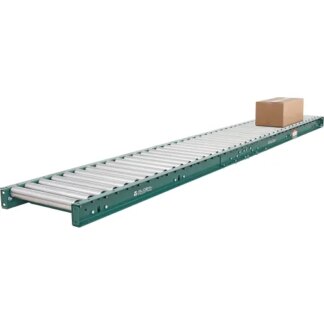
The GRAVITY ROLLER CONVEYOR 10FT 15″ 3″ AXLE is a straight-section, unpowered conveyor system designed to move pallets, cartons, and packages through warehouses, distribution centers, and manufacturing facilities using gravity or manual push. This essential material handling equipment provides a cost-effective solution for smooth product flow without requiring electricity or complex mechanical components.
Key specifications and features make this gravity roller conveyor an excellent choice for high-volume operations. The 10-foot length provides substantial product movement capability while remaining compact enough for most facility layouts. The 15-inch frame width accommodates standard pallet sizes and moderate carton dimensions, while the 3-inch axle center spacing ensures load distribution across multiple roller points. With a robust 120 lbs/ft load capacity, this conveyor handles typical warehouse loads including palletized goods, boxed inventory, and bulk materials. The gravity-fed design eliminates maintenance costs associated with motorized systems—no belts, chains, or motors to service. Steel construction provides durability in high-traffic environments, and the smooth roller surface prevents product damage during transit. The straight section configuration makes installation straightforward and allows seamless integration with existing conveyor systems or as a standalone gravity line.
Common applications and user profiles span numerous industries relying on efficient material movement. Warehouse and fulfillment centers use gravity roller conveyors to streamline order picking and package routing. Manufacturing facilities integrate these systems into production lines for moving components and finished goods between workstations. Food and beverage distributors depend on gravity conveyors for temperature-neutral product handling without electricity concerns. Retail distribution networks utilize these systems for receiving, sorting, and shipping operations. Postal and parcel operations employ gravity conveyors for automated sortation without powered mechanisms. The product suits small-to-medium operations, regional distribution hubs, and large-scale logistics centers equally well, making it versatile across manufacturing, e-commerce, automotive, pharmaceutical, and industrial sectors.
When selecting gravity roller conveyor systems, several factors deserve careful consideration beyond basic dimensions. Evaluate your actual load requirements—knowing whether you’re moving lightweight boxes or heavy pallets determines if the 120 lbs/ft capacity suits your needs. Consider the incline of your installation: gravity conveyors perform optimally on slight declines (typically 2-5 degrees) but require manual assistance or power assistance on level surfaces. Assess roller diameter and material composition relative to your product type—3-inch axles indicate standard industrial-grade rollers suitable for most applications, but fragile items may require specialized roller covers. Review spacing requirements between rollers to ensure products don’t sag or get caught during transit. Examine frame construction quality and bearing types, as sealed bearings resist contamination better in dusty environments. Plan for expandability by confirming compatibility with additional conveyor sections, transfer units, and support frames. Calculate total system length needed, including any curves or transitions, and verify floor space availability for installation. Account for maintenance access—gravity systems need periodic cleaning and occasional roller replacement, so design your layout for serviceable access.
What load capacity should I choose for my application?
The GRAVITY ROLLER CONVEYOR 10FT 15″ 3″ AXLE features a 120 lbs/ft capacity, meaning each running foot of conveyor can safely support 120 pounds distributed across its length. For example, a single 5-foot-long pallet weighing 500 pounds distributes at 100 lbs/ft, well within specification. Calculate your heaviest anticipated load, divide by the number of rollers supporting it simultaneously, and compare against the 120 lbs/ft rating. If your loads exceed this specification consistently, consider multiple parallel conveyor lines or heavy-duty gravity systems with reinforced construction.
How do I install a gravity roller conveyor on a level floor?
Gravity roller conveyors operate most efficiently with a slight downward slope (2-5 degrees) allowing products to move via gravity alone. On perfectly level surfaces, you must manually push products or install a powered drive roller at one end. Mount the conveyor frame securely to the floor using appropriate fasteners for your surface type—concrete anchors for concrete floors, lag bolts for wooden structures. Ensure frame legs are level using a spirit level, then adjust feet or shims as needed. Verify roller rotation moves freely before loading. For level installations without motorization, train operators on proper pushing techniques to prevent injury and product damage.
What is the difference between gravity and motorized roller conveyors?
Gravity roller conveyors rely on product weight or manual pushing for movement, requiring no electricity, offering lower capital and operational costs, producing no noise, and needing minimal maintenance—perfect for variable-flow applications. Motorized roller conveyors feature powered drive rollers enabling continuous product movement regardless of incline, accommodating higher throughput rates, controlling speed precisely, and handling heavier loads efficiently—ideal for high-volume, continuous-operation environments. Choose gravity systems for flexible, low-maintenance operations; select motorized systems for predictable, high-speed production requirements. Many facilities utilize both types strategically positioned throughout their layouts.



Reviews
There are no reviews yet.