Description
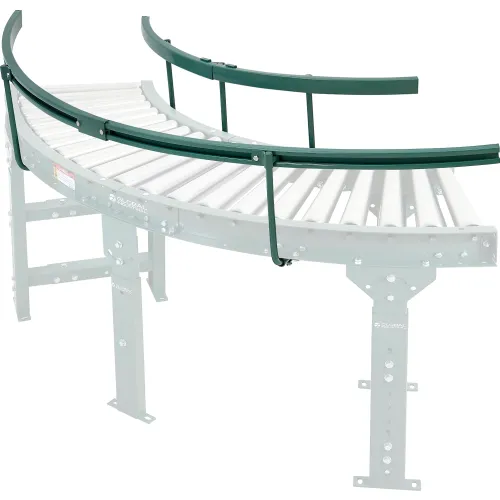
Conveyor Side Guards 90 Curve 24″ OAW are protective barriers designed specifically for 90-degree curved conveyor sections with a 24-inch overall width. These guards prevent material spillage, contain product debris, and enhance worker safety at curved conveyor transitions where lateral displacement commonly occurs.
These industrial-grade side guards feature precision engineering to fit seamlessly on curved conveyor systems operating at 90-degree angles. Key specifications include a 24-inch overall width (OAW) dimension, compatible with standard conveyor frame mounting systems, and construction from heavy-duty steel or reinforced polymer materials depending on your application requirements. The curved profile matches the conveyor’s bend radius, ensuring proper alignment and eliminating gaps where material could escape. Installation utilizes standard bolting patterns and requires minimal modification to existing conveyor infrastructure. The guards feature smooth interior surfaces that reduce friction and material hang-up during operation, while the exterior design allows for easy cleaning and maintenance access. These components meet CEMA (Conveyor Equipment Manufacturers Association) standards and are engineered to withstand the lateral forces and material pressures typical in high-speed or loaded conveyor operations.
Conveyor side guards for 90-degree curves are essential components in food processing facilities, mining operations, aggregate handling plants, automotive manufacturing, pharmaceutical production, and packaging distribution centers. Industries utilizing bulk material handling, loose product conveyance, or fragile item transport rely on these guards to maintain product integrity and minimize material loss at critical transition points. Manufacturing plants processing powders, granules, pellets, or small discrete items benefit from complete containment during directional changes. Facilities handling wet or sticky materials find curved guards particularly valuable as they prevent material buildup and maintain consistent product flow through bends.
When selecting conveyor side guards for 90-degree curves, evaluate your specific conveyor width and confirm the 24-inch OAW dimension matches your system’s specifications. Material selection is critical—steel guards offer superior durability for abrasive materials and high-impact environments, while polymer options reduce noise and work well with lighter loads or sanitary applications. Assess mounting compatibility with your existing conveyor frame to ensure proper installation without expensive modifications. Consider the height of the guard relative to your material’s trajectory and conveyor operating speed; faster conveyors and taller loads may require taller guards. Verify that the curved guard radius matches your conveyor’s bend radius precisely—mismatched geometry creates spillage points and uneven wear. Examine surface finish requirements for your industry; food-grade and pharmaceutical applications need smooth, crevice-free construction. Finally, factor in accessibility for cleaning, inspection, and maintenance, as buildup inside guards can affect conveyor balance and operational efficiency.
What size conveyor system is this guard designed for?
The 24-inch overall width (OAW) specification indicates this guard is engineered for conveyor systems with a 24-inch belt or deck width. This dimension is a standard size in industrial conveyor applications, commonly used in mid-capacity systems handling moderate to heavy product volumes. Before purchasing, measure your conveyor’s actual width between the frame edges where the guard will mount. The OAW measurement accounts for the full width of the installed guard assembly, so ensure your conveyor frame has adequate clearance. If your conveyor width differs slightly, custom sizing options may be available through most industrial suppliers.
How do I install these guards on my existing 90-degree curved conveyor section?
Installation typically involves positioning the curved guard alongside the conveyor’s outer edge at the 90-degree bend and securing it using the standard bolt holes on your conveyor frame. Most guards use carriage bolts, washers, and lock nuts for secure fastening. Begin by removing any existing guard components or obstruction, then align the guard’s mounting brackets with the frame holes. Tighten fasteners in a cross pattern to ensure even pressure and prevent misalignment. Verify that the guard’s curve matches your conveyor’s bend radius and that there are no gaps between the guard and frame where material could escape. Check clearance with surrounding equipment or structures. For safety, ensure the conveyor is powered off and locked out during installation. If your conveyor frame lacks standard mounting holes, drilling may be necessary; use appropriate drill bits for your frame material and consult load-bearing calculations if adding holes near critical structural areas.
What is the difference between 90-degree curved guards and standard straight conveyor guards?
Ninety-degree curved guards are engineered specifically for directional change sections where material experiences lateral force due to the bend. Straight guards work on linear conveyor runs but cannot accommodate the geometry of a 90-degree turn without creating gaps and spillage points. Curved guards follow the conveyor’s bend radius, maintaining continuous containment as material transitions through the corner. The 24-inch OAW curved guard is dimensionally and structurally optimized for this angled application, with reinforcement positioned to handle the directional stresses unique to curved sections. Straight guards used incorrectly on curves result in material loss, safety hazards, and operational inefficiency. Selecting the correct guard type—curved for bends, straight for tangent runs—is essential for conveyor system optimization and regulatory compliance.
Order your Conveyor Side Guards 90 Curve



Reviews
There are no reviews yet.