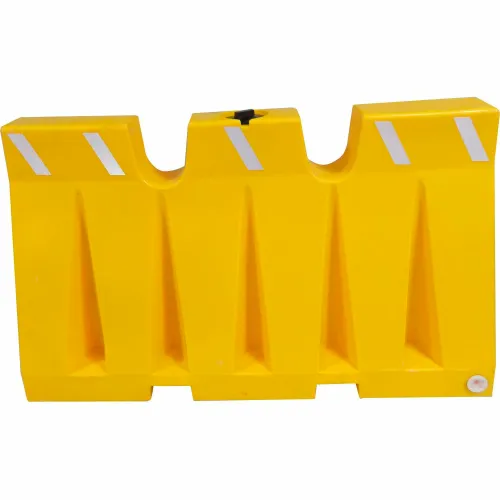
Description
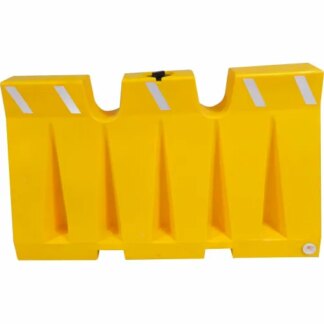
The INTERLOCK SAFETY BARRICADE YELLOW 71.25x24x43 is a high-density polyethylene (HDPE) modular crowd control and work zone barrier designed for temporary traffic management, event perimeter protection, and hazard containment. This fillable safety barricade delivers professional-grade perimeter control for construction sites, roadwork, facility maintenance, and public events where temporary, reusable barriers are essential.
Key features and specifications of this safety barricade include its durable HDPE construction, which resists UV degradation, chemical exposure, and weather damage—critical for long-term outdoor deployment. Measuring 71.25 inches in length, 24 inches in width, and 43 inches in height, this barrier provides substantial visual obstruction and physical containment. The fillable design accommodates both water ballast and sand ballast, allowing operators to adjust weight distribution and stability based on ground conditions and wind exposure. Reflective safety strips on both sides enhance visibility during low-light conditions, day or night, improving workplace safety and reducing accident risk. The interlocking system enables seamless connection of multiple units, creating extended barricade runs without gaps or separation. The lightweight yet sturdy construction allows manual installation without heavy equipment, reducing setup labor costs while maintaining structural integrity under pressure.
Construction contractors, municipal departments, event management companies, and facility maintenance teams rely on this barricade for diverse applications including traffic redirection, pedestrian crowd management, hazard zone isolation, equipment storage perimeter protection, and temporary work zone boundaries. Common deployment scenarios include highway construction zones, parking lot management during repairs, warehouse renovation projects, outdoor festival and concert perimeter setup, parking area lane closures, maintenance area containment, and temporary pedestrian pathway redirection. The modular nature makes these barriers ideal for operations requiring reconfigurable layouts—users can reposition, extend, or contract the barricade line as project phases evolve.
When evaluating safety barricades for procurement, prioritize several critical factors: weight capacity and stability ratings relative to your expected wind load and contact pressures; material durability including UV resistance and chemical compatibility with your work environment; visibility features such as reflective strip brightness and reflectivity rating compliance; ballast compatibility and maximum fill weight specifications; interlocking mechanism design and connection strength; dimensional specifications ensuring proper clearance and sight lines; portability and storage footprint for facilities with limited equipment space; and long-term cost of ownership factoring replacement cycles and maintenance requirements. Additionally, verify compliance with OSHA guidelines, MUTCD (Manual on Uniform Traffic Control Devices) standards, and any local municipality requirements for temporary barriers in your jurisdiction. Consider bulk purchasing options and volume discounts if deploying across multiple project sites or maintaining permanent inventory for frequent deployments.
What is the maximum water or sand capacity for this barricade?
This 71.25x24x43 inch barricade accommodates approximately 50-55 pounds of water ballast or 60-70 pounds of sand ballast when filled to safe operational capacity. However, always verify exact capacity specifications on the product documentation, as overfilling compromises stability and interlocking connection integrity. Water ballast offers easier handling and faster deployment, while sand ballast provides superior wind resistance in high-exposure locations. Consider your installation location’s wind conditions and ground stability when selecting ballast type—wet sand or water works better on stable, level surfaces, while dry sand provides optimal friction on sloped or loose terrain.
How do I connect multiple barricades to create an extended barrier line?
The INTERLOCK SAFETY BARRICADE features an integrated interlocking mechanism on both front and rear edges designed for seamless unit-to-unit connection. Simply position adjacent barricades end-to-end and engage the interlock connectors—no additional hardware or fasteners required. The interlocking system prevents units from separating under lateral pressure or crowd contact, maintaining continuous barrier integrity across extended runs. When installing, ensure ground surface is level and compacted to maximize contact stability. For high-traffic or high-impact areas, fill all connected units simultaneously to maintain uniform weight distribution and barrier strength. Most operators can connect 5-8 units per minute once familiar with the interlocking procedure, enabling rapid large-scale deployments.
What is the difference between water-fillable and sand-fillable barricades for my application?
Water-fillable barricades (including this model) offer faster setup since water sources are typically available on-site—simply connect a hose and fill. Water ballast is lighter than sand, reducing manual handling strain and transport weight per unit. However, water requires drainage procedures before repositioning and may present freezing concerns in cold climates. Sand-fillable barricades provide superior wind resistance and maintain weight stability without drainage requirements, making them ideal for permanent or semi-permanent installations. Sand doesn’t freeze, flows around irregular ground surfaces for better ground contact, and doesn’t spill if the barrier cracks. For most industrial applications requiring flexibility and rapid redeployment, water-fillable systems like this model provide superior operational efficiency. For high-wind environments or long-term stationary installations, sand ballast systems may offer better stability and reduced maintenance demands.
This safety barricade ships quickly from our extensive


Reviews
There are no reviews yet.