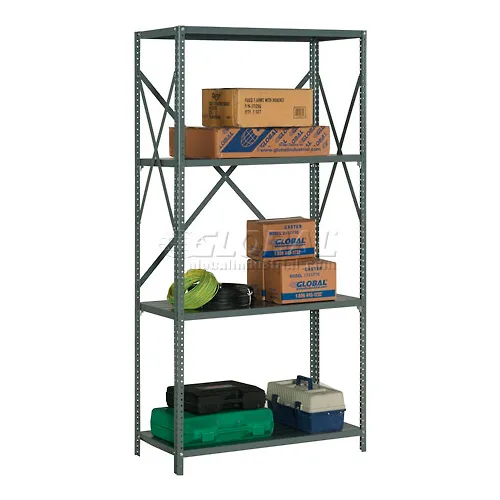
Description
18 Gauge Open Steel Shelving 48×12 73H 4 Shelves is a heavy-duty storage solution designed for warehouses, manufacturing facilities, retail stockrooms, and industrial environments that require reliable, high-capacity organization. This open shelving unit provides immediate access to stored materials without doors or enclosures, making it ideal for frequently accessed inventory and supplies.
Key Features & Specifications: This steel shelving unit measures 48 inches wide by 12 inches deep by 73 inches high, providing 4 adjustable shelves that deliver 2,304 cubic feet of storage capacity. Constructed from 18-gauge steel with a durable powder-coated finish, this unit offers superior corrosion resistance and longevity in demanding industrial environments. Each shelf features reinforced edge beading to prevent sagging and warping under heavy loads, while the open frame design maximizes visibility and accessibility to stored inventory. The unit is engineered to support substantial weight distribution across multiple shelves, with adjustable shelf heights allowing 9.5-inch clearance between shelves for customizable storage configurations. The 18-gauge steel thickness provides an optimal balance between structural integrity and cost-effectiveness, making this unit suitable for both light and moderate to heavy-duty applications. Bolt-together assembly requires minimal tools, and the unit does not require wall anchoring for freestanding installation, though optional bracing kits are available for enhanced stability in high-traffic areas.
Applications & User Base: This open shelving unit serves manufacturers, distribution centers, retail businesses, automotive facilities, food service operations, and maintenance departments across North America. Common applications include storing tools, parts, equipment, raw materials, finished goods, safety equipment, and administrative supplies. Industrial shelving of this configuration is particularly popular in metal fabrication shops, assembly plants, warehouses, and cross-dock facilities where staff need quick access to inventory without opening doors or navigating enclosed storage systems. Retailers use similar units for back-room organization and seasonal merchandise storage, while healthcare facilities utilize them for medical supply management and equipment storage. The open design makes these units especially valuable in quality control areas, order fulfillment centers, and production floors where visual inventory counts and rapid item retrieval are operational priorities.
What to Consider When Selecting Open Shelving: When evaluating steel shelving units for your facility, prioritize the load capacity per shelf—verify that weight requirements for your specific stored items fall within manufacturer specifications to ensure safety and longevity. Consider the shelf depth of 12 inches in relation to your inventory dimensions; while this depth is ideal for smaller components and supplies, larger items may require deeper units. Evaluate adjustable shelving versus fixed configurations; adjustable shelves provide flexibility as storage needs evolve, though fixed shelves offer slightly higher load ratings. Assess environmental factors including humidity, temperature fluctuations, and chemical exposure; the powder-coated steel finish provides standard corrosion protection suitable for most indoor environments, though specialized coatings exist for aggressive settings. Verify assembly requirements and labor costs versus pre-assembled alternatives. Calculate total floor space allocation, including aisle width and accessibility; a 48-inch-wide unit represents a compact footprint suitable for space-constrained facilities. Compare open frame shelving against enclosed or caster-equipped alternatives based on your workflow and mobility needs.
What size loads can each shelf support?
Each shelf in this 18-gauge unit typically supports 300–500 pounds of evenly distributed weight, depending on load distribution and shelf support configuration. Maximum unit capacity reaches 1,200–2,000 pounds total across all four shelves. Always verify specific load ratings in the technical specification sheet, as capacity varies based on load distribution patterns—concentrated loads at shelf edges reduce capacity compared to evenly dispersed loads across the shelf surface. For heavy-duty applications exceeding standard capacity, consult reinforced industrial shelving alternatives with thicker gauge steel or additional bracing.
How do I adjust shelf heights on open shelving units?
Adjustable shelving utilizes simple shelf support clips or post holes that allow vertical repositioning. Remove items from the shelf you wish to reposition, lift the shelf slightly to disengage support pins or clips from the vertical posts, slide the shelf up or down to the desired height (typically offering 1-inch increments), and re-engage the support mechanism. This process requires no tools and takes minutes per shelf, making reconfiguration practical for changing storage needs. Ensure shelves remain level after adjustment by using a spirit level and verifying equal post engagement on all four corners.


Reviews
There are no reviews yet.