Description
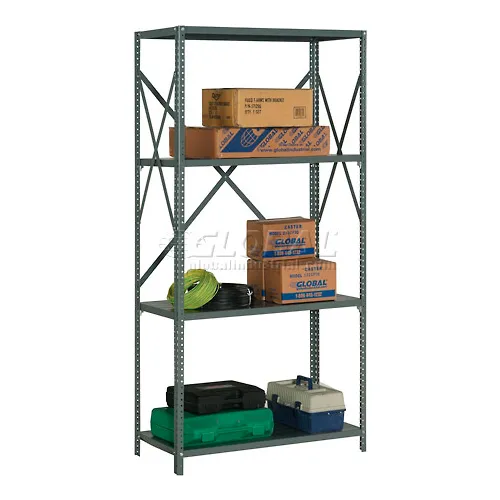
20 Gauge Open Steel Shelving 48×30 73H 4 Shelves is a heavy-duty storage solution designed for warehouses, manufacturing facilities, retail stockrooms, and industrial workspaces. This open-frame shelving unit provides accessible, cost-effective bulk storage without the expense of enclosed cabinetry.
This industrial-grade shelving system features 20 gauge steel construction, which offers superior strength and load capacity compared to lighter gauge alternatives. The unit measures 48 inches wide by 30 inches deep by 73 inches tall, with four adjustable shelves that accommodate standard pallet depths and common storage bin dimensions. Each shelf is engineered to distribute weight evenly across the frame, and the open design eliminates obstruction when accessing stored materials. The steel shelving frame is built with vertical supports and horizontal cross-members that resist deflection under moderate to heavy loads. The 4-shelf configuration provides 3 usable storage levels plus the base, making this unit ideal for maximizing vertical storage space in facilities with 8-10 foot ceiling heights. This shelving unit arrives with all necessary hardware and mounting brackets, allowing for quick assembly without specialized tools. The industrial-grade welds and reinforced corner joints ensure durability in demanding warehouse and manufacturing environments.
Open shelving units like this are widely used across manufacturing, distribution, retail, and maintenance departments. Warehouse managers deploy these systems for general merchandise storage, parts inventory management, and overflow stock organization. Manufacturing facilities use them to store raw materials, work-in-process components, and finished goods prior to shipment. Retail stockrooms benefit from the visibility and accessibility—staff can quickly locate and retrieve products without opening doors or removing obstacles. Maintenance departments store tools, equipment, and supplies within easy reach. Automotive shops, food distribution centers, medical supply warehouses, and e-commerce fulfillment centers all rely on open steel shelving for its reliability and ease of reconfiguration. The open-frame design allows for efficient material handling with pallet jacks, hand trucks, and forklifts, making this shelving ideal for high-throughput operations.
When selecting open steel shelving for your facility, consider several critical factors: gauge thickness directly impacts load-bearing capacity—20 gauge provides excellent strength for general industrial use, while heavier gauges suit extreme-load applications. Verify weight capacity per shelf and total unit capacity against your inventory requirements. Assess whether you need adjustable shelving to accommodate various product sizes or fixed shelves for maximum stability. Evaluate depth dimensions carefully; 30-inch depth is standard but may require adjustment for specific bin or pallet configurations. Consider height compatibility with your facility’s ceiling clearance and aisle requirements—73 inches fits under most standard 8-foot ceilings while leaving headroom. Determine whether you need welded or bolt-together construction; bolt-together units offer greater flexibility for reconfiguration and future expansion. Check for rust prevention finishes if your environment involves moisture or corrosive materials. Finally, evaluate total installed cost including delivery, assembly labor, and any required anchoring to walls for seismic stability or safety compliance.
What is the weight capacity per shelf on this 48x30x73 unit?
The 20 gauge steel shelving supports approximately 300-500 pounds per shelf, depending on load distribution and shelf span. For maximum capacity and safety, distribute weight evenly across the shelf surface and avoid concentrating heavy loads at shelf edges. Always consult your facility’s safety requirements and local building codes, and consider load testing if you anticipate maximum-capacity use. For loads exceeding 500 pounds per shelf, upgrade to 18 gauge or heavier steel construction.
How do I adjust the shelves on this open shelving unit?
The shelves rest on shelf supports or notches along the vertical frame members, allowing you to reposition them to different heights. To adjust: (1) unload the shelf completely, (2) lift the shelf slightly to clear the support brackets or notches, (3) slide it horizontally to the desired height position on the frame, and (4) ensure the shelf is fully seated on all four support points. Most industrial shelving uses either welded angle supports or bolt-hole patterns spaced 1-2 inches apart, enabling fine adjustment. No tools are typically required for repositioning, making reconfiguration fast and convenient for changing storage needs.
What is the difference between 20 gauge and 18 gauge steel shelving?
The primary difference is material thickness and load capacity. 20 gauge steel measures 0.0359 inches thick, while 18 gauge measures 0.0478 inches—roughly 33% thicker. This additional thickness increases load capacity per shelf by approximately 40-60%, making 18 gauge shelving suitable for heavier inventory, dense storage applications, and high-traffic warehouse environments. 18 gauge units also exhibit less shelf deflection under load and provide



Reviews
There are no reviews yet.